Five Suggestions for Better Conversation on Time to Talk Day 2026
With Time to Talk Day coming, we look at several ways families can have better conversations with each other. Less argy-bargy, more listening on all sides!
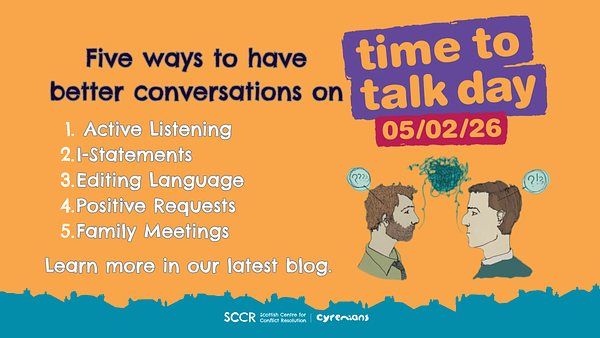
Date for your diaries: Thursday, 5 February, which is when the UK holds Time to Talk Day 2026.
Time to Talk Day is run by Mind and Rethink Mental Illness, both of which are leading mental health charities. The day is being held to reduce the stigma that still attaches itself to the issue of mental health. The idea is to dispel shame by getting people to start conversations about mental health. These conversations can come in as many shapes and forms as the people who take part in them. Whether you chat over a cup of coffee in a café or while going for a walk, whether it’s in-person or online, the idea is to connect and to listen.
Mind and Rethink Mental Illness describe Time to Talk Day as the nation’s biggest conversation about mental health. It gives people who are struggling a chance to express how difficult they’re finding things and to seek help.
It’s always ‘time to talk’ at SCCR, and if you look through our website and its resources, you will find lots of ideas for how to have difficult conversations. Relationship breakdown within families remains the leading driver of youth homelessness in Scotland. We can better protect our relationships with those closest to us if we can find a way to talk to each other that doesn’t worsen a situation.
Below, we present some ideas to make conversations between parents and young people.
Active Listening
Before you talk, listen.
We can’t resolve any conflict if we are not talking and listening to each other.
If young people feel that they aren’t being listened to at home, they might be less likely to confide in their family. However, if a parent or carer actively listens to their young person, meaningfully taking in what they tell them and then work together to come up with solutions based on both of their needs, then they may reach a positive outcome in which both parties are satisfied.
To encourage someone to talk about what’s going on for them, first, let them know that you’re listening to their concerns and that you’re taking them seriously.
Active listening is a set of techniques you can use to meaningfully listen. It is a highly useful conflict resolution tool that helps diffuse tension and helps resolve conflict. If you want to learn more about active listening, click here (scroll down a wee bit to get to that part).
I-Statements
When you do talk, think about how to phrase what you want to say.
It’s all too easy to slip into blaming statements such as ‘you always’ or ‘you never’. These statements don’t leave space to explain how we are feeling and can often cause the other person to become defensive. If we use ‘I’ and ‘we’ instead, we can clearly express our needs and encourage others to do the same. These are called ‘I-Statements’.
If you’d like to learn more about them, click here.
Editing Language
Frequent conflict with family members can have a negative impact on mood. It’s too easy to focus on the negatives and forget about the positives. To get a conversation of to a good start:
- focus on the positive
- edit out complaints
- edit self-criticism
If you’d like to learn more about editing language, click here (scroll down a wee bit until you come to that section).
Positive Requests
Parents and carers often become tetchy when their requests are ignored as they must ask again and again, making them feel like a nag – which no one enjoys.
We can, however, get in the habit of asking for things in a way that can make a young person tune out.
The answer is positive requests.
Positive requests give parents and carers a blueprint for asking for something in a polite yet assertive way, avoiding the sort of blaming language that can harm relationships. It helps us explain to Young People why we are asking them to do something, which should make it likelier that they will do what a parent or carer has asked them to do.
Here’s what to do.
_(1).png)
For example, you could say
- 1. I would really appreciate it if you (did X).
- 2. I think I would feel more (add feeling).
To give an example:
‘I would really appreciate it if in the future, you could tell me where you are going and when you will be back. Instead of feeling jumpy and anxious, I think I would feel much calmer, knowing that you were safe.
If you’d like to learn more about positive requests, click here (scroll down a wee bit until you come to that section).
Family Meetings
A family meeting is a discussion which many parents find to be a helpful way to end conflict. The aim of these meetings is to give everyone in the family a chance to talk about how they’re feeling, including issues related to conflict, and for the family to work together to come up with solutions.
If you’d like to learn more about what makes for a successful family meeting, click here.
Finally, remember – there are lots of different ways to get mark Time to Talk Day. You can share a post on social media using #TimeToTalk – or, better still, check in with a friend or family member.
If you’d like to learn more about positive requests, click here (scroll down a wee bit until you come to that section).
Learn more about Time to Talk Day 2026 here.