Introducing Mind Works: A User Guide – Practical Support for Professionals Working with Families in Conflict
SCCR's new Mind Works booklet brings together a decade's worth of digital resources, with suggestions for activities for professionals, practitioners, and volunteers who work with families.
If you work with young people, parents or carers, you know family conflict is complex. Whether you're a teacher, youth worker, social worker, counsellor, mediator, health professional or volunteer, finding practical ways to help families communicate better and end conflicts can make a real difference.
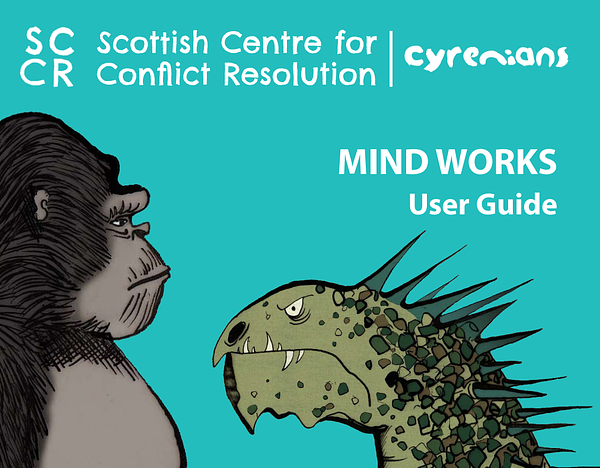
Mind Works: A User Guide is a new free resource, a booklet published to support professionals, practitioners and volunteers. The User Guide introduces SCCR resources and provides activities professionals can use in school, community and family support settings based on these resources.
Available now and free to download from SCCR’s website (click here), the guide brings together the four interactive resources SCCR has developed over the past decade: Monkey Vs Lizard, Keep the Heid, Cranial Cocktail and The Three Brains.
In the booklet you’ll find activities, discussion prompts and facilitation guidance to support emotional regulation, wellbeing and the de-escalation of conflict.
Real-world practice rarely follows a script. The booklet was written so that professionals, practitioners and volunteers can adapt the activities depending on circumstances. Sessions can be shortened, adapted or developed, whatever you or the individuals or groups you are working with need in the moment. The activities are designed so that you can complete an entire programme around a resource or select a single activity when time is limited. Mind Works: A User Guide is a practical toolkit you can adapt according to need.
The booklet explores four resources:
- Monkey vs Lizard helps participants understand the difference between reactive ‘fight, flight or freeze’ responses and more reflective, empathetic responses to conflict.
- Keep the Heid explores anger, emotional regulation and the idea of ‘flipping your lid’, helping people recognise triggers and develop coping skills.
- Cranial Cocktail explains emotional states through brain chemicals, body sensations and emotions, helping participants recognise and regulate how they feel.
- The Three Brains introduces the mind-body connection between the brain, heart and gut, encouraging families to look after their wellbeing in the hope they’ll be less likely to argue when feeling good about themselves.
Together, these resources make complex scientific ideas accessible and practical. They draw on evidence from fields such as neuroscience, psychology and emotional wellbeing, translating theory into engaging conversations and activities that can be used in classrooms, youth work settings, family support services, mediation practice and community organisations.
For education professionals, the resource offers particular value. Mind Works: A User Guide is aligned with the principles of Getting It Right For Every Child (GIRFEC) and supports outcomes within Scotland's Curriculum for Excellence, particularly in Health and Wellbeing. Teachers can therefore use the activities confidently within classroom learning, personal and social education, pastoral care and wider wellbeing initiatives.
At its heart, Mind Works: A User Guide is about making the science of emotions, conflict and relationships easy to understand and apply. It recognises that every family, every young person and every professional context is different. Rather than offering a rigid programme, it provides flexible, evidence-informed tools that can be adapted to suit your work, whether you have an hour-long session planned, ten minutes for a conversation, a small group workshop or a one-to-one intervention. The information and activities in the booklet help turn understanding into action, supporting stronger relationships and helpful responses to conflict.
Download your free copy today and discover how Mind Works: A User Guide can support your work with families.